The former Kingdom of Siam is one of those destinations that people talk about long before they ever set foot there. Its reputation has been shaped by decades of intensive tourism, yet the country has managed, not without effort, to preserve what matters most: a highly rich cultural identity, exceptional terrestrial and marine biodiversity, and a genuine hospitality that goes straight to the heart.
For foreign travellers, the country initially presents two contrasting faces. First, there are the crowded beaches of Phuket and Koh Samui, or the frenetic pace of Bangkok: familiar postcard images that have travelled the world, even to those who have never been there. Then there is the Thailand you discover when you take the time to venture north, follow the Burmese and Lao borders, explore Isaan and the eastern region, and venture into national parks and mountain villages where the hill peoples still live with pride.
Arrival in Bangkok
Bangkok, or Krung Thep, as it is known in Thai, is a capital city unlike any other. Vast, noisy and unpredictable, it makes an immediate impression on visitors from the moment they land and never quite lets go. Along the khlongs, the canals that still flow through certain neighbourhoods such as Thonburi, life unfolds at a pace that seems worlds away from the city's congested avenues: boat vendors, stilt houses and discreet temples tucked between modern buildings. Wat Pho, with its 46-metre-long Reclining Buddha, Wat Arun, catching the evening light from the opposite bank of the Chao Phraya River, and the Grand Palace with its gilded walls form the city's historic heart. They are best explored early in the morning, before the heat and crowds set in.
But Bangkok is also Chinatown and its aromatic alleyways, the Banglamphu district with its second-hand bookshops, the floating markets of Damnoen Saduak, best visited at dawn, and the Chatuchak Weekend Market, one of the world's largest open-air markets, where you can happily lose yourself for hours. The city comes alive as much at night as during the day, fuelled by an energy that never really fades and one of Asia's most inventive street-food scenes.
The East: From Bangkok to Cambodia
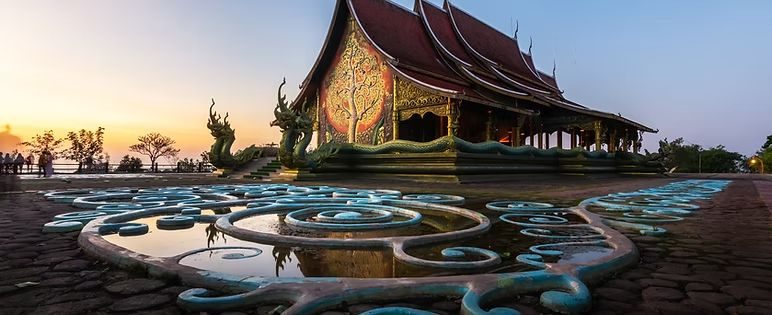
Leaving Bangkok and heading east, the coastline along the Gulf of Thailand gradually comes into view, revealing a very different side from the image it sometimes has. Pattaya, often caricatured for its excessive and frenetic nightlife, is also home to a lively marina, an exceptional botanical garden, the remarkable Sanctuary of Truth—a wooden temple built right on the beach—nearby islands accessible by ferry, and a surprising hinterland of orchards and vineyards. Further along the coast, Koh Samet, an island national park just two hours from the capital, offers white-sand beaches with exceptionally fine sand, in a setting that has retained a pleasantly intimate feel.
At the far end of the coastline, Trat, accessible by air from Bangkok, is the gateway to the unspoilt little archipelago of Koh Chang, Koh Kood and Koh Mak, set right on the doorstep of Cambodia. Koh Chang, the country's third-largest island, has on several occasions been recognised as one of the world's most beautiful tropical island. Covered in rainforest across almost its entire territory, it has been part of a national park since 1982, a status that protects it from overly ambitious development. The eastern half of the island is consequently almost entirely overlooked by visitors, both Thai and foreign, making it an ideal retreat for those seeking peace and quiet.
This string of islands appeals to travellers looking for a more distinctly Thai, peaceful and unhurried experience. Koh Kood, in particular, remains relatively untouched by tourism, with its dense mangroves, waterfalls and exceptionally clear waters. It also takes pride in having no parties, not a single 7-Eleven, and in preserving its distinctive character.
Isaan, the rural soul of Thailand
The Isaan plateau, a vast region in the northeast stretching towards the Mekong River and the borders with Laos and Cambodia, is perhaps the country's largest, least-known and, paradoxically, most authentic region. There are no beaches here and few glittering temples. Instead, there are rice fields stretching as far as the eye can see, villages where time follows the rhythm of the agricultural seasons, water buffalo grazing through the changing seasons, cuisine that is spicier and more straightforward than anywhere else in the country, and a quietly generous population, little accustomed to foreign visitors.
Phu Kradueng National Park, with its cliffs, pine forests and high-altitude meadows, is one of the country's most beautiful natural areas, yet remains relatively undiscovered. Be aware that it closes during the rainy season to allow wildlife to breed undisturbed. Along the Mekong, the towns of Nong Khai and Mukdahan offer the chance to follow the river through an almost otherworldly landscape, facing the Lao hills reflected in the water at sunset. Nong Khai is also the starting point for the Friendship Bridge, which connects Thailand and Laos, for those wishing to continue their journey across the river.
The North and its treasures
Chiang Mai is the natural gateway to northern Thailand, one of the country's most charming cities and particularly popular with French visitors. Surrounded by mountains and forests, it is home to more than 300 temples, including the majestic Doi Suthep, perched at an altitude of 1,000 metres. Reaching it involves climbing 309 steps guarded by two nagas, the mythical serpents of Buddhist cosmology. The city thrives on its vibrant crafts scene, remarkable food culture and a night market that reinvents itself every week.
From Chiang Mai, you can explore Chiang Rai and its otherworldly Wat Rong Khun, the White Temple, or head towards the Golden Triangle, the historic crossroads between Thailand, Laos and Myanmar, where the Mekong winds between the hills in a soft haze. In the surrounding area, Karen, Akha and Lahu villages welcome visitors through community-based tourism, offering an experience that feels more like a genuine encounter than a staged attraction.
The South and its archipelagos
Southern Thailand unfolds as a succession of islands and peninsulas between the Andaman Sea and the Gulf of Thailand: two distinct atmospheres, two different shades of blue.
On the Andaman coast, Phuket and Krabi attract the greatest numbers of visitors with their stunning beaches and spectacular scenery. They are ideal destinations for travellers looking to party, enjoy the company of a large European community of tourists and expatriates, and take advantage of the amenities that come with it. Koh Lanta and the Trang Islands, meanwhile, offer more unspoilt beaches, a gentler pace of life and world-class diving, with leopard sharks, manta rays and sea turtles.
On the Gulf side, alongside bustling Koh Samui and its neighbour Koh Phangan, which has a more family-friendly atmosphere outside the Full Moon Party period, Koh Tao remains the go-to destination for earning a diving certification in warm, welcoming waters.
In recent years, Thailand has introduced a policy of temporarily closing certain natural sites to allow them to recover. Maya Bay, made famous by the film The Beach, is the most emblematic example, reflecting a genuine shift in awareness that is gradually changing the face of tourism in the region.
National parks
Doi Inthanon National Park, home to Thailand's highest peak at 2,565 metres, offers hiking trails through misty forests inhabited by more than 360 bird species, making it one of Asia's most popular birdwatching destinations. Khao Sok National Park, in Surat Thani province in southern Thailand, is home to one of the world's oldest tropical rainforest ecosystems. Gibbons, gaurs and the spectacular Rafflesia, the world's largest flower, thrive together in an environment that has remained largely untouched. Khao Yai National Park, 180 kilometres from Bangkok, is one of the best places to encounter Thailand's impressive wildlife, including macaques, Asiatic black bears and wild elephants. It is arguably one of the few places where you can see these animals as they should be seen: free in their natural habitat, indifferent to the silent visitor observing them from a respectful distance.
Generally speaking, the rainy season, from June to October, is well worth considering: lush vegetation, fewer visitors and lower prices. For those who appreciate taking their time and making genuine connections, it is often the best season to visit.
Cuisine
Thai cuisine is one of the most complex and balanced in Southeast Asia. It is best discovered in morning markets, family-run roadside eateries and noodle soups slurped down standing up at dawn. The more adventurous may be tempted by grilled insects, ant eggs and various larvae, which may or may not appeal depending on one's stomach.
Each region has its own specialities: khao soi, a Northern Thai coconut milk noodle curry; seafood in the South; and som tam, a spicy green papaya salad found throughout the country. Food lies at the heart of Thai hospitality and everyday life. This is a vibrant cuisine, deeply rooted in daily traditions, and one that people are naturally happy to share with just about anyone.
Living alongside Thai people
Theravada Buddhism permeates every aspect of daily life. Temples and places of worship should be visited quietly and with the respect they naturally deserve: shoulders and knees covered, shoes removed before entering.
The monarchy occupies a central and deeply respected place in Thai society, something visitors quickly come to understand as they observe everyday life in the country. It is less a matter of constraint than a key to understanding what holds the population and its culture together.
Thai people are generally open and tolerant towards other cultures, provided those cultures respect their own. Sharing a drink or a meal—one of their favourite times of day—is undoubtedly the most relaxed way to get to know the locals.